Runtipi vs Umbrel: Choosing the Right Self-Hosting Platform for Your Homelab

Self-hosting has become increasingly popular among developers, homelab enthusiasts, and privacy-conscious users. Instead of relying on third-party cloud providers, self-hosting allows you to run applications on your own infrastructure—giving you full control over your data and services.
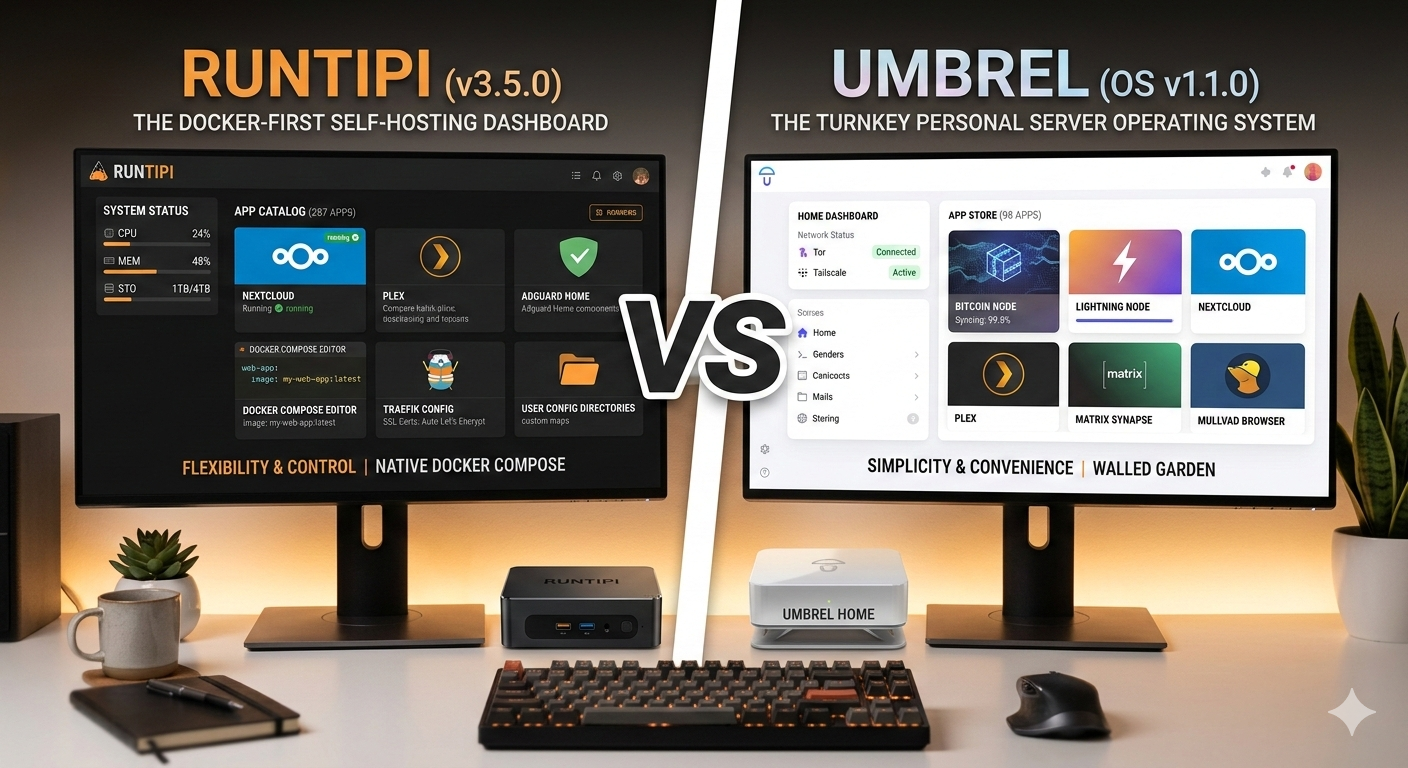
Two popular platforms that simplify this process are Runtipi and Umbrel. Both aim to make self-hosting easy by providing a web dashboard, one-click app installations, and containerized deployment. However, they take different approaches in architecture, flexibility, and target audience.
This article provides a technical comparison of Runtipi and Umbrel, focusing on architecture, features, extensibility, and ideal use cases.
What Is Runtipi?
Runtipi is an open-source homeserver management platform designed to simplify the deployment of self-hosted applications using Docker containers. It provides a dashboard that lets users install and manage apps with minimal configuration.
The platform is built on top of Docker and Docker Compose, enabling users to run and manage multiple services from a centralized interface.
Key Features of Runtipi
- One-command installation on most Linux systems
- Web dashboard for managing services
- Nearly 300 available self-hosted applications in the app catalog
- Docker container isolation for security
- One-click app installation and updates
- Backup and restore features
- Ability to modify Docker Compose configurations
Runtipi focuses on flexibility and customization while still maintaining ease of use.
What Is Umbrel?
Umbrel is a self-hosting platform delivered as a dedicated operating system (umbrelOS) designed to run on personal servers or Raspberry Pi devices.
Umbrel originally gained popularity in the Bitcoin community because it allowed users to run a Bitcoin node easily. Over time, it evolved into a broader self-hosting ecosystem with an app store and web interface.
Key Features of Umbrel
- Dedicated operating system for self-hosting
- Clean web dashboard for system and app management
- App store with pre-configured services like Nextcloud and Wiki tools
- One-click updates for the system and applications
- Privacy-focused design where all data remains on local hardware
- Support for Raspberry Pi and x86 servers
Umbrel emphasizes simplicity and a polished user experience.
Architecture Comparison
| Feature | Runtipi | Umbrel |
|---|---|---|
| Platform Type | Application layer on Linux | Full operating system |
| Container Runtime | Docker / Docker Compose | Docker (managed by Umbrel) |
| Installation | Single command script | Install umbrelOS or run via script |
| Customization | High (editable Compose files) | Limited outside official app store |
| Target Hardware | Any Linux server | Raspberry Pi, mini PCs, servers |
Key Difference
Runtipi runs on top of your existing Linux environment, while Umbrel replaces your OS with a purpose-built system.
This architectural difference significantly affects flexibility and control.
App Ecosystem
Runtipi
Runtipi provides an extensive app catalog with over 260 self-hosted services, including:
- AI tools
- Media servers
- automation services
- developer tools
- infrastructure utilities
Users can also add custom services by editing Docker Compose files.
Umbrel
Umbrel provides a curated App Store with popular self-hosted applications such as:
- Nextcloud
- Syncthing
- developer utilities
- file sharing tools
The catalog is easier for beginners but smaller and more controlled compared to Runtipi.
Ease of Use
Umbrel
Umbrel is often considered the most beginner-friendly option in the self-hosting space.
Advantages:
- Polished UI
- minimal configuration
- fully integrated OS
- one-click app deployment
Because Umbrel controls the entire system stack, the user experience is extremely streamlined.
Runtipi
Runtipi is also user-friendly but assumes slightly more technical knowledge.
Advantages:
- Runs on existing Linux servers
- integrates with existing Docker environments
- easier to extend with custom containers
For developers and homelab enthusiasts, this flexibility is often preferable.
Security and Isolation
Both platforms rely heavily on Docker containerization, which isolates services from each other.
Runtipi specifically highlights that each application runs in its own container environment, improving security and stability.
Umbrel also benefits from container isolation but adds another layer by controlling the entire OS environment.
Community Feedback
Self-hosting communities often highlight key differences between the two platforms.
For example, discussions on Reddit suggest that Umbrel excels in UI and simplicity, while some users prefer alternatives with larger app catalogs or more customization options.
Similarly, some Runtipi users report using it because it provides pre-configured Docker apps that would otherwise require manual setup.
Pros and Cons
Runtipi
Pros
- Large app catalog
- Runs on any Linux server
- Highly customizable
- Docker-native architecture
- Ideal for homelab setups
Cons
- Slightly steeper learning curve
- Requires Linux server setup
- Smaller community compared to older platforms
Umbrel
Pros
- Beautiful and intuitive UI
- Extremely beginner-friendly
- Dedicated operating system
- Simple app deployment
Cons
- Limited customization
- Smaller app catalog
- Less control over Docker environment
When to Choose Runtipi
Runtipi is ideal if you:
- already run Linux servers
- want deeper Docker control
- manage multiple services
- enjoy customizing infrastructure
It works well for developers, DevOps engineers, and homelab builders.
When to Choose Umbrel
Umbrel is best if you:
- are new to self-hosting
- want a plug-and-play solution
- prefer a polished UI
- don't want to manage Linux manually
It’s perfect for personal cloud servers or simple home deployments.
Final Verdict
Both Runtipi and Umbrel aim to simplify self-hosting, but they target different audiences.
- Umbrel prioritizes simplicity and user experience.
- Runtipi prioritizes flexibility and infrastructure control.
For beginners, Umbrel is often the easier starting point.
For developers and homelab enthusiasts, Runtipi usually offers more power and customization.
Ultimately, the best choice depends on whether you value ease of use or extensibility.